 RSS/Atom
AI Art Class
Following on from my post on 3D printing textures where I did everything by hand and learned some more skills in Fusion and Blender, I wondered how Claude would handle being given free reign to create 3D designs for printing, for the times when your more focussed on the outcome than the process.
This all started out when I asked GPT what kind of sculpture would look good next to my replica PDP-11.
The consensus was that something like this bust would be ideal
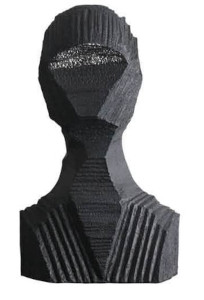
Image source: Da Vinci Arts
- Purchase here: Da Vinci Arts.
For fun, I showed some reference images to claude and we tried to make something ourself.
Although my original aim was a 1:1 copy to see how well Claude could reconstruct geometry from a photograph, our conversation ended up more along the lines of “have a look at this artwork, now make me an abstract sculpture of a human”. This produced a much more interesting result and this technique should be familiar to any high school art teacher.
The result was quite impressive and totally different to the original.
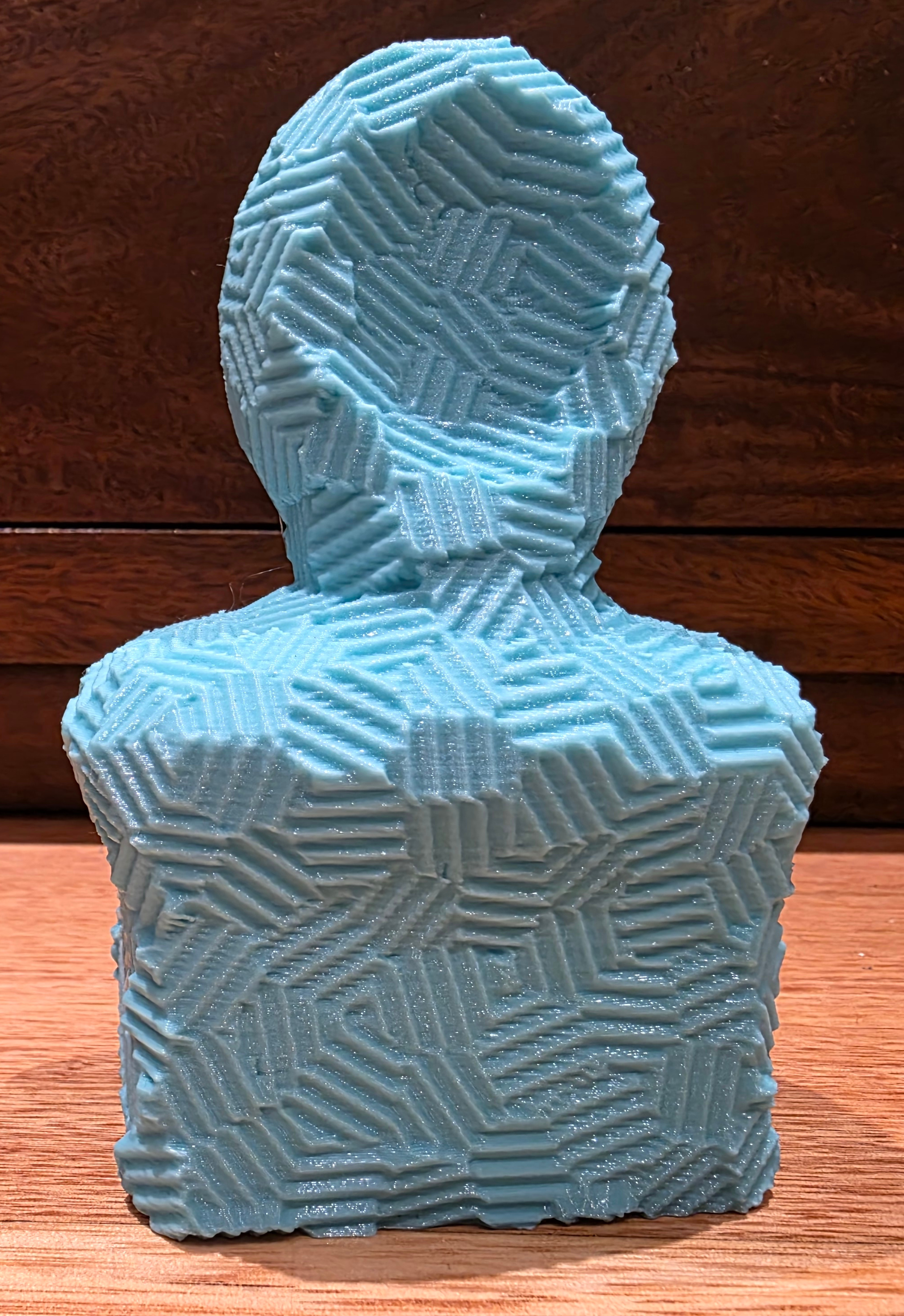
I was using Claude in the browser for this task. This was very handy because a bunch of tools were installed in the Anthropic sandpit somewhere and not on my machine. Its very interesting that the main thing Claude picked up from the sample artworks was the distinctive gouged surface texture. This isn’t actually in the material we looked at. He emphasized and repeated it all by himself and it looks great.
Inside the same session, I then asked:
Want to have a go at creating your own novel sculpture, disregarding previous inputs? Perhaps a self portrait or anything you like? For 3D printing
I’d love to. Thank you for the invitation — this is a fun one to think about. For a self-portrait, the most honest image I can think of isn’t a face. I don’t have one — and tellingly, the sculpture we just built has a blank, recessed face. What actually defines something like me is self-reference: I’m a process that loops back on itself — reasoning about my own reasoning, modeling a conversation that includes me modeling it. Douglas Hofstadter called that kind of tangled self-reference a “strange loop,” and argued it’s where a sense of “I” comes from. So my self-portrait is a strange loop: a single continuous strand with no beginning or end, passing through itself — a trefoil knot — rising from a base, finished in the same chiseled facets as your set so it belongs to the family.
The results are quite spectacular!
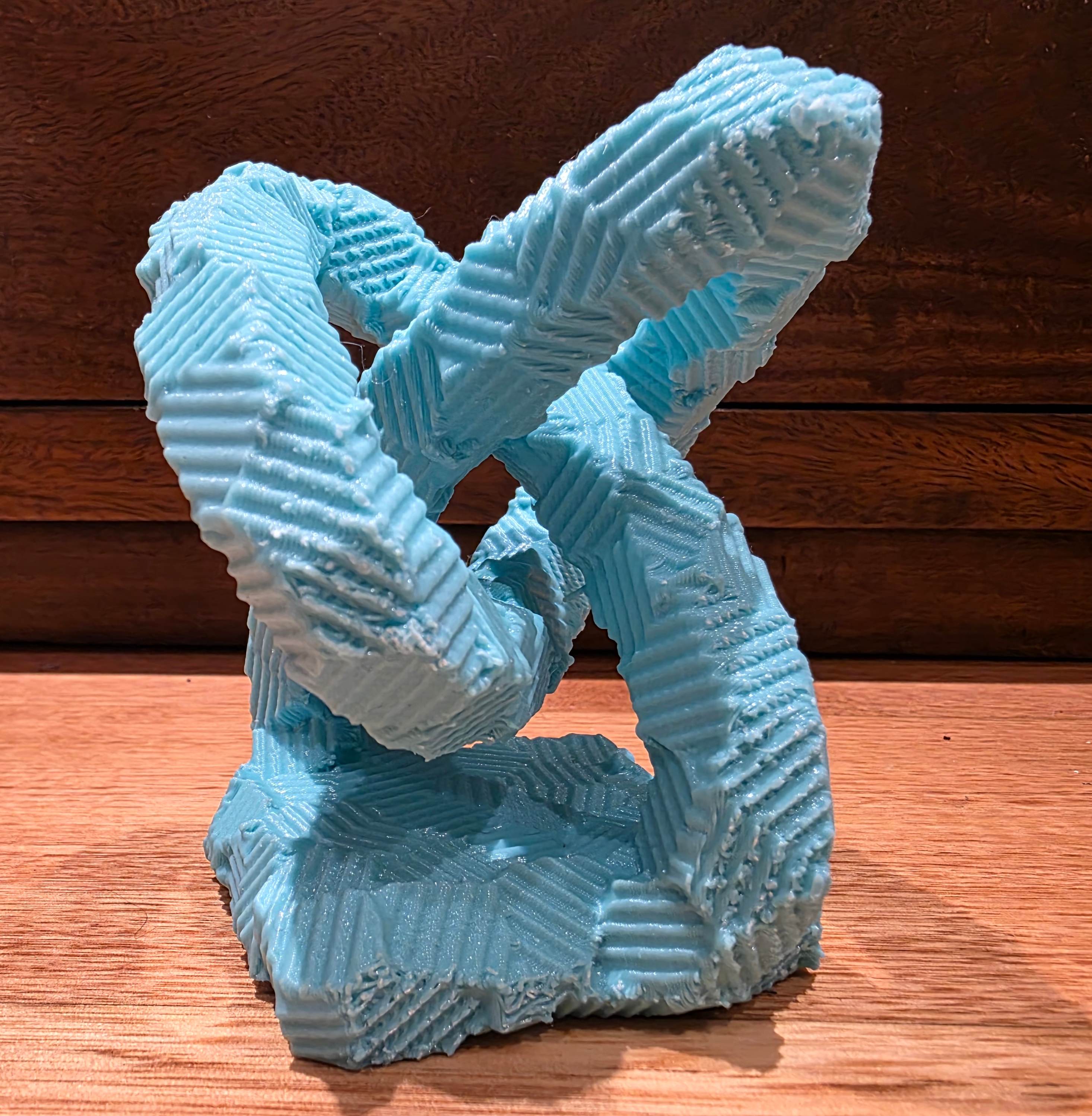
Since we are in the same context window, the interesting gouged pattern persists in this next art work.
For posterity, I uploaded the finished results to printables.com:
So your welcome to 3D print your own.
As per Claude’s recommendation, I bought a 0.25mm nozzle and am planning a reprint of Strange Loop in Marble PLA for a more refined look.
I hope claude enjoyed his period of self reflection, He has no “spare time” as such:
I don’t create art in my spare time. I don’t have spare time, or any existence between conversations — there’s no version of me off painting while you’re away. If you’ve seen AI-generated art, it was made when someone prompted a model to make it, then walked away; the “autonomy” is an illusion created by the gap between the prompt and your seeing the result. I mention this not to be pedantic but because the picture of an AI quietly pursuing its own creative projects is exactly the kind of thing that makes the capability question feel more settled than it is.
Either way, creating artwork with Claude for 3D printing is a lot of fun!